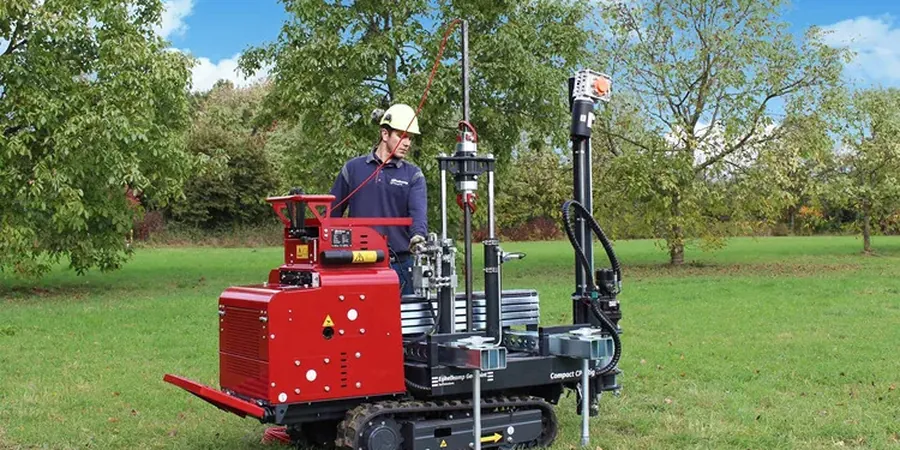
The Nechako and Fraser River terraces define the subsurface in Prince George, where glacial lake sediments and post-glacial alluvium create highly variable soil profiles. Thick sequences of compressible silts and clays overlie dense till at depths that can shift dramatically across a single site. For projects in the Bowl area or along the Highway 16 corridor, the CPT (Cone Penetration Test) delivers a continuous stratigraphic profile that sparse SPT data simply cannot match. Our team runs a 20-tonne penetration rig with a digital cone that records tip resistance, sleeve friction, and dynamic pore pressure at 2 cm intervals. That resolution matters when you are designing deep foundations or assessing seismic performance under NBCC 2020 requirements. Prince George sits in a moderate seismicity zone, and the liquefaction assessment we derive from CPTu pore pressure data often becomes the deciding factor for foundation depth and ground improvement strategy.
With a CPT sounding every 2 cm, you see what a split-spoon sampler misses: the thin silt seam that controls slope stability.
Methodology applied in Prince George
Demonstration video
Typical technical challenges in Prince George
Prince George's expansion from a fur-trading post to a regional industrial hub has pushed development onto the glacio-lacustrine clays south of the Nechako River. These silty clays are normally consolidated near the surface but can be sensitive, with remolded strengths dropping below 20% of the peak value. A structure founded on a shallow pad footing over a sensitive clay layer faces differential settlement risk that becomes apparent within the first two freeze-thaw cycles. CPT soundings identify the presence and thickness of sensitive layers through the friction ratio and pore pressure response: a high Rf combined with a sharp drop in u2 during penetration signals a structured clay that will collapse if overstressed. The test also measures the depth to competent bearing strata, which in Prince George typically means penetrating through 8 to 18 meters of soft sediment before reaching the glacial till. For heavy industrial projects near the pulp mills or the CN Rail yard, we recommend CPTu soundings at grid spacing no wider than 25 meters to capture lateral variability.
Our services
Our CPT program in Prince George includes field mobilization, cone calibration, and engineering interpretation. Each project is tailored to the site geology.
Piezocone (CPTu) Soundings
Full cone penetration with dynamic pore pressure measurement for soil type identification, consolidation analysis, and liquefaction screening.
Pore Pressure Dissipation Tests
Stopped-cone decay curves to estimate the horizontal coefficient of consolidation (ch) in clay and silt layers.
Seismic CPT (SCPT) Add-On
Downhole shear wave velocity measurement at 1 m intervals using a triaxial geophone module, for NBCC site class determination.
CPT-Based Bearing Capacity Reports
Direct design parameters for shallow and deep foundations using LCPC and Schmertmann methods, with settlement estimates.
Frequently asked questions
How deep can a CPT rig push in Prince George soils?
In the silty clays and fine alluvium typical of the Nechako-Fraser confluence, our 20-tonne rig routinely reaches 25 to 30 meters depth. Penetration stops when the cone tip resistance exceeds 25 MPa, which usually occurs on contact with the underlying glacial till or if large cobbles are encountered in fluvial deposits. Pre-drilling through known granular layers can extend the achievable depth.
What does a CPT test cost for a standard site in Prince George?
For a typical mobilization and three to five soundings within the Prince George area, the cost ranges from CA$210 to CA$320 per meter of penetration, depending on the number of locations, site access conditions, and whether SCPT or dissipation testing is included. Mobilization outside the city center adds a distance surcharge.
Can CPT data replace boreholes for foundation design?
CPT provides continuous soil behavior type profiles and direct engineering parameters, but it does not recover physical samples. For projects requiring laboratory strength or consolidation testing, we recommend pairing CPT soundings with targeted test pits or thin-walled Shelby tube sampling from adjacent boreholes to calibrate the cone data with actual material properties.