The biggest mistake we see in Prince George is treating Nechako River valley silts like competent till. A contractor assumes stand-up time, mobilizes a roadheader, and within hours the face starts raveling. The soil here doesn't behave like Vancouver glacial drift, it's a postglacial, normally consolidated deposit that loses suction fast when disturbed. A proper soft ground tunnel analysis has to quantify undrained strength degradation, pore pressure response, and arching potential before the portal is even cut. Without that, a routine urban sewer drive turns into a sinkhole at 3rd Avenue. Our lab runs the full suite of consolidation, triaxial, and index tests needed to feed a calibrated PLAXIS or RS2 model that reflects the actual stratigraphy beneath the city.
Stand-up time in Prince George silts can drop below 30 minutes once the soil suction dissipates, a condition that standard SPT blow counts often miss.
Methodology applied in Prince George
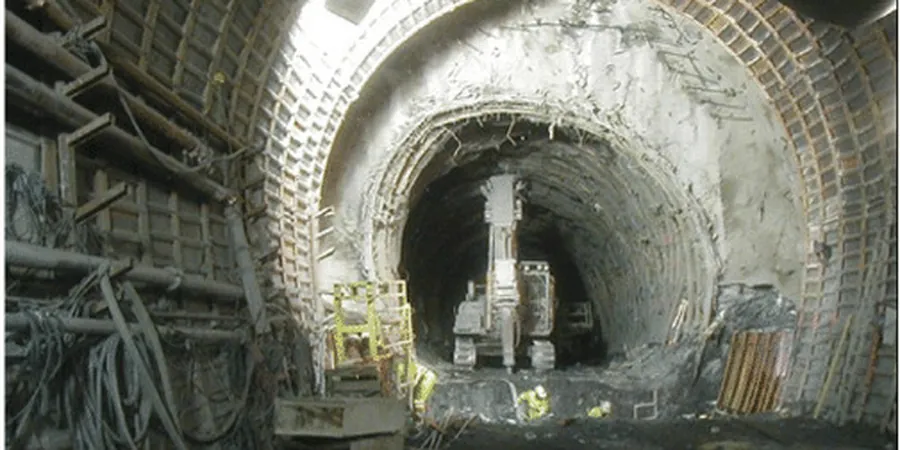
Typical technical challenges in Prince George
The contrast between the cutbanks near the Nechako River and the plateau around the Hart Highlands illustrates the risk perfectly. Downtown Prince George sits on up to 40 meters of soft, compressible silt, while the upper benches have denser ablation till. A tunnel boring through the valley bottom faces not only face instability but long-term consolidation settlement that can drag down adjacent buildings. We've seen cases where a 2-meter-diameter sewer tunnel induced 60 millimeters of surface settlement simply because the contractor underestimated the volume loss. Our approach combines pre-excavation grouting to stiffen the crown and systematic excavation monitoring with inclinometers and surface settlement points. For deeper structures, we also evaluate the risk of basal heave when the excavation approaches the artesian gravels that underlie the silt at depth.
Our services
Every soft ground tunnel in Prince George starts with a defensible ground model. Here's how we build it.
Laboratory Strength and Stiffness Testing
We run K0-consolidated undrained triaxial and oedometer tests on undisturbed Shelby tube samples to define the hardening soil parameters for PLAXIS, including Eur, Eoed, and the Mohr-Coulomb failure envelope under in-situ stress conditions.
Field Investigation and Instrumentation
CPTu soundings with pore pressure dissipation tests let us map the stratigraphy at centimeter resolution and estimate the coefficient of consolidation directly. We also install vibrating wire piezometers to track groundwater response during construction.
3D Finite Element Simulation
Our numerical models incorporate face pressure, staged excavation sequences, and the effect of pre-support elements like spiles and forepoling, giving the contractor a clear window of allowable deformation before the shotcrete lining is activated.
Frequently asked questions
How much does a geotechnical analysis for a soft ground tunnel in Prince George typically cost?
The scope varies with tunnel length and depth, but for a typical urban utility tunnel project in Prince George, the combined field investigation, laboratory testing, and numerical modeling ranges between CA$5,510 and CA$21,730, depending on the number of boreholes, the complexity of the stratigraphy, and whether advanced triaxial tests are required.
What makes Prince George silts so challenging for tunneling?
The glaciolacustrine silts deposited in the former glacial lake that filled the Nechako basin are normally consolidated and have high sensitivity. They contain varved layers of fine sand that act as drainage paths, accelerating pore pressure equalization and causing rapid loss of apparent cohesion when the face is exposed.
Which support methods work best in these soil conditions?
Based on local experience, a sequential excavation method with a curved pipe umbrella canopy, systematic face dowels, and a quick-setting shotcrete lining applied within 2 hours of excavation provides the most reliable face control. Pre-injection of microfine cement through the canopy pipes further reduces the permeability of the crown.