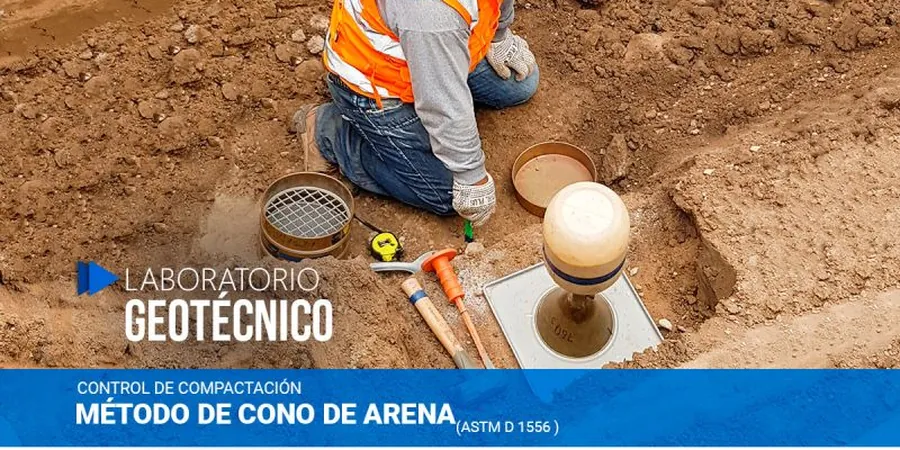
In Prince George, we see a recurring issue: density specs written for southern BC clays simply do not translate to the local glacial till. The grain-size curve here is wide, often gap-graded, and it compacts differently than what a lab Proctor might suggest if the field crew isn't careful. That is precisely why we run the field density test with the sand cone in the actual lift, right after the roller passes. We combine it with a Proctor curve calibrated for the borrow source and a quick grain-size check on the same material to confirm the lab reference still matches the pad. The sand cone method—ASTM D1556-15—remains the most reliable direct-measurement approach for compacted soils in this region, especially when nuclear gauges give questionable readings on micaceous silts common near the Nechako River.
A percent compaction number means nothing if the lab Proctor was run on a sample that doesn't represent what the roller is hitting.
Methodology applied in Prince George
Typical technical challenges in Prince George
Prince George has expanded across terraces of the Fraser and Nechako rivers where fill thickness can vary from half a meter to over four meters in old channel scars. A historical note: much of the industrial land near the rail corridors was backfilled with boiler ash and wood waste through the mid-20th century before modern compaction standards existed. When we test density on a new warehouse pad in these zones, we are often the first to flag a soft pocket that a proof roll missed. The sand cone gives us a point measurement—accurate but discrete—so the risk is extrapolating too far between tests. In non-homogeneous fill, we tighten the test grid and cross-reference with dynamic cone penetration to catch lateral variability that a single density hole will not see.
Our services
Field density testing in Prince George usually fits into a larger quality assurance package. These are the three services we most frequently mobilize alongside the sand cone:
Modified Proctor Compaction Test
We run both standard and modified Proctor (ASTM D1557) on your borrow material to establish the target dry density and optimum moisture before any fill placement begins.
In-Place Moisture Content
Every sand cone hole includes a moisture determination by oven-drying. For fast turnaround on large pads, we also run a field microwave method correlated against the lab.
Fill Source Evaluation
Before importing thousands of cubic meters, we sample and test the source pit for gradation, Proctor, and organic content to confirm it meets spec for the project.
Frequently asked questions
How much does a sand cone density test cost in Prince George?
A single field density test with the sand cone typically runs between CA$130 and CA$220, depending on travel distance within the Prince George area and whether we bundle it with lab Proctor work. Volume pricing applies for ongoing earthworks QA programs with a daily minimum.
Why choose the sand cone over a nuclear density gauge?
Nuclear gauges require licensing, secure transport, and can drift calibration on the micaceous silts common along the Nechako. The sand cone is a direct measurement of excavated volume and mass—no radiation, no calibration shift on odd mineralogy, and it is accepted without question by every geotechnical engineer in Northern BC.
How do you handle oversize particles in the hole?
ASTM D1556 limits the method to soils with a maximum particle size of about 2 inches. If we encounter a cobble in the test hole, we discard the test, move half a meter, and re-excavate. For fills with frequent oversize, we run a rock correction on the Proctor and supplement density testing with large-scale field trials.
What is the minimum number of tests per day for a compaction job?
The BC Building Code and typical project specs call for at least one test per lift per 250 square meters of compacted area, or one per 150 cubic meters placed. On a standard residential pad in Prince George, that usually means 4 to 6 sand cone tests in a single day's fill operation.
Do you need a geotechnical engineer to interpret the results?
Our field technicians report percent compaction against the lab Proctor immediately on site. For structural fill under footings or slabs, the engineer of record reviews the data set. We can provide a signed summary report within 24 hours for routine compaction acceptance.