Prince George grew from a fur trading post into a major industrial hub, shaped by its position at the confluence of the Fraser and Nechako rivers. That growth brought infrastructure onto challenging terrain: steep riverbanks, post-glacial deposits, and fine-grained lacustrine sediments that behave poorly under load. Designing a retaining wall here means accounting for more than just soil pressure. The region’s freeze-thaw cycles, fluctuating groundwater, and proximity to active transport corridors demand a design approach rooted in local data. Our team relies on subsurface investigation methods like test pits to map the upper stratigraphy and confirm the extent of desiccated clay crusts, which often govern shallow bearing capacity. Whether a project involves a modest landscape wall or a tiered structure supporting a commercial development, the geotechnical input defines long-term performance.
A retaining wall in Prince George must handle freeze-thaw cycles that transform backfill drainage from a maintenance item into a structural necessity.
Methodology applied in Prince George
Typical technical challenges in Prince George
At 575 meters above sea level with a population approaching 80,000, Prince George sits in a zone where the seismic hazard, while moderate, cannot be ignored for earth-retaining structures. The 2015 revision of the NBCC raised spectral acceleration values for the region, pushing many wall designs out of the prescriptive scope and into mandatory engineering review. The bigger day-to-day risk, however, is water. A poorly drained wall backfill in the local silty matrix can develop hydrostatic pressures that double the design load within a single rain-on-snow event. Frost action adds another layer: ice lens formation in the retained soil can produce lateral movements that crack stiff stem walls before the first thaw. When the wall supports a public right-of-way or a building foundation, these failures cascade into costly remediation. A solid geotechnical investigation that quantifies groundwater seasonality and soil frost susceptibility is the only way to calibrate safety factors that actually hold through a Prince George winter.
Our services
The variety of site conditions across Prince George—from compact gravel terraces near the airport to soft clays in the Hart Highlands—means no single wall type fits every project. Our scope covers the full geotechnical workflow behind the structural design:
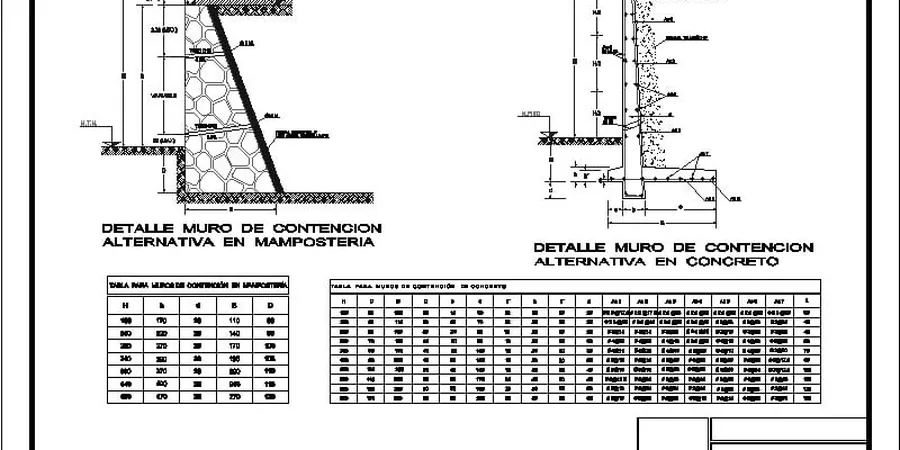
Cantilever and Gravity Wall Design
Reinforced concrete cantilever walls and mass gravity walls for residential and commercial sites. We provide bearing capacity checks, overturning and sliding stability calculations, and global stability verification using limit equilibrium methods calibrated to local till and clay parameters.
Anchored and Soldier Pile Systems
For tight right-of-way constraints along Prince George's older neighborhoods, anchored systems minimize excavation. We design the bonded length based on in-situ shear strength profiles and specify corrosion protection suitable for the mildly acidic soil pH common in the region.
Drainage and Frost Protection Design
A critical companion to any retaining wall in northern BC. We detail granular chimney drains, filter fabric gradation, base drain connections to storm systems, and rigid insulation placement to isolate the wall stem from frost-susceptible backfill.
Frequently asked questions
What is the typical cost range for retaining wall design in Prince George?
Geotechnical design fees for a retaining wall in Prince George typically range from CA$1,500 to CA$6,100, depending on wall height, site access, and the extent of subsurface investigation required. A simple gravity wall under 1.5 meters on a known soil profile sits at the lower end, while a multi-tiered anchored system requiring boreholes and slope stability modeling falls at the higher end.
At what height does a retaining wall require a professional engineer in BC?
Under the BC Building Code, a retaining wall exceeding 1.2 meters in height, or any wall supporting a surcharge such as a driveway or building, generally requires a professional engineer's design. Walls in sensitive soils or near property lines may require engineering regardless of height.
How do Prince George winters affect retaining wall performance?
Frost penetration here reaches 1.5 to 2.0 meters, which is deeper than many southern BC locations. Without proper drainage and insulation, ice lenses can form in the backfill and apply additional lateral pressure. We specify free-draining backfill, filter fabric, and sometimes rigid insulation on the stem to isolate the wall from frost-jacking forces.
What type of backfill do you recommend for walls in the local silty soils?
Native till from local borrow sources can work well if it meets a specified gradation with less than 5 percent fines. More often, we recommend importing a clean, crushed granular material meeting the 20 mm minus specification, compacted in lifts with density testing referenced to a modified Proctor value. This prevents water retention and reduces lateral earth pressure.
Can you design a retaining wall on a slope in the Cranbrook Hill area?
Yes. Sloped sites require a combined approach: the wall itself must be stable against sliding and overturning, and the overall slope must have an adequate factor of safety. We use cross-sections from the specific lot to model global stability and often specify a deeper key or a row of anchors if the slope angle exceeds 2H:1V.