The soil profile changes dramatically between the Nechako River flats and the higher benchlands of the Hart. Down near the river you are usually into silty alluvium with a high natural moisture content, while up on the plateau the glacial till is much drier and contains a lot of cobble-sized material. Getting the right compaction specification starts with knowing which Proctor method applies. In Prince George, the standard Proctor often suits the silty sands, but the modified Proctor is what we recommend for structural fill and heavy-duty pavement subgrade. We run both in our laboratory so the data matches the actual material your crew is placing. When we see fill that needs to support deep frost penetration, we also tie the results back to grain-size analysis to confirm fines content.
A well-run Proctor test tells you exactly where the soil transitions from stiff to unstable. In Prince George silts, that window is often narrower than you think.
Methodology applied in Prince George
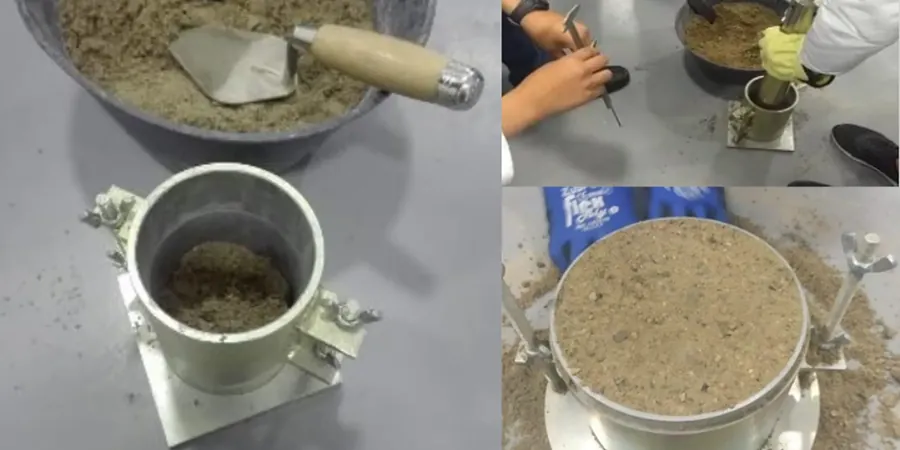
Typical technical challenges in Prince George
We see one mistake more than any other in Prince George: contractors running a single modified Proctor on a borrow source and using that one curve for the entire site. The material changes. A pit can transition from sandy gravel to silty sand in thirty meters, and the optimum moisture can shift by three or four points. If nobody catches it, the compaction testing in the field will fail repeatedly and nobody will know why. Another common error is ignoring the oversize correction. When the fill contains 30 percent gravel, the lab density without correction is not representative of the field material, and the specification becomes impossible to meet. Taking the time to run the right Proctor variant, on the right sample, saves weeks of rework.
Our services
Our laboratory in the region provides the full compaction evaluation workflow, from sample preparation to a certified report. We handle the material the way it will behave in the field.
Standard Proctor (ASTM D698)
Appropriate for low to moderate loading conditions, landscaping fills, and utility trench backfill where the native silty soils of the Prince George basin are placed without heavy roller compaction.
Modified Proctor (ASTM D1557)
Specified for structural fill under footings, road subbase, and airport pavement. We apply the higher compactive effort and correct for gravel content to match the aggregate sources common in the Cariboo region.
Field Compaction Correlation
We combine the Proctor curve with field density testing to produce a direct comparison. The lab result becomes the target line for nuclear gauge or sand cone measurements on your active lift.
Frequently asked questions
How much does a Proctor test cost in Prince George?
A standard or modified Proctor test typically runs between CA$160 and CA$260 per sample, depending on the method and whether an oversize correction is needed. The price covers the full compaction curve with five or more points, moisture content determination, and a signed report.
How long does it take to get results from a Proctor test?
We can usually turn around a single Proctor curve in two to three working days. Rush service is available. The timeline depends on the material: a clean sand dries faster than a fat clay, and the modified procedure requires more compaction blows per layer, which adds to the lab time.
Which Proctor method should I use for a driveway in Prince George?
For a residential driveway on native silty sand, a standard Proctor is generally sufficient. If you are importing crushed aggregate and using a large vibratory roller, the modified Proctor gives a more realistic target density. The key is matching the lab effort to the compactive energy your equipment actually delivers.