Builders in Prince George know the soil changes fast between neighborhoods. Over in the Hart Highlands you hit dense glacial till with a mix of gravel, sand, and silt that drains reasonably well. Down in the Bowl area, near the confluence of the Fraser and Nechako rivers, it's a different story, with thick layers of fine silts and clays laid down by millennia of flooding. That variability is exactly why a proper grain size analysis matters. The full sieve plus hydrometer suite gives you the entire particle size distribution, from coarse gravel right down to the sub-74-micron fraction. Without that curve, you are guessing on frost susceptibility, drainage behavior, and how the material will compact. It is the single most cost-effective test to avoid surprises once the excavator starts cutting. For projects on the silty terraces south of town, we often pair this data with Atterberg limits to define the plastic behavior of the fine fraction, since a non-plastic silt behaves very differently from a lean clay during spring thaw.
A grain size curve is not just a classification exercise; it predicts how water moves through the soil and how the ground will behave during freeze-thaw cycles.
Methodology applied in Prince George
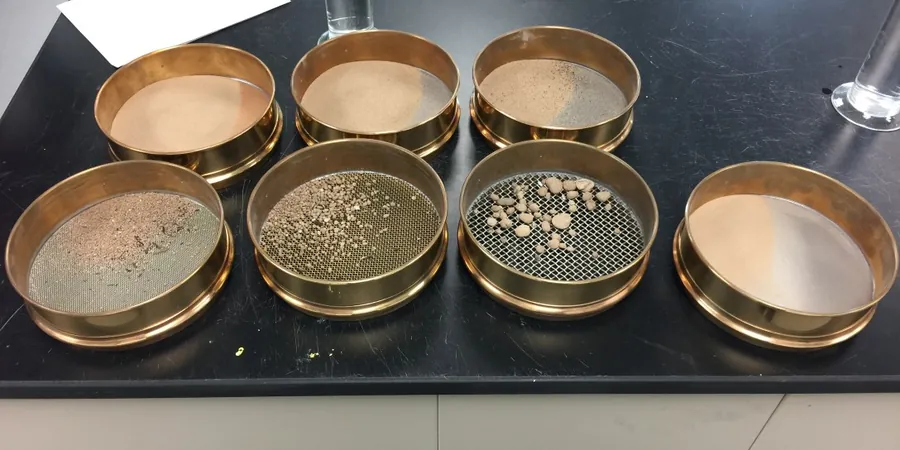
Typical technical challenges in Prince George
Prince George sits at the junction of two major rivers on a bed of glaciolacustrine silts and clays that can be saturated well into July after a heavy snowpack year. When grain size is misinterpreted, the consequences cascade quickly. A soil logged as clean sand but actually carrying 35 percent silt will not drain as designed, leading to perched water behind retaining walls or prolonged softening under footings during the spring melt. The frost depth in this region regularly reaches 1.8 meters per the National Building Code of Canada, and any material with more than 10 percent passing the 75-micron sieve is considered frost-susceptible unless specifically tested. We have reviewed projects where a missed fine fraction forced expensive sub-excavation and replacement after a single winter. The grain size curve also feeds directly into liquefaction screening; the silty sands along the Fraser River terraces fall into gradation bands that are known to be contractive under seismic loading. With Prince George classified as Seismic Category 3 under the 2020 NBCC, ignoring the particle distribution is a liability no engineer or owner should accept.
Our services
Our laboratory in Prince George handles the full workflow from sample preparation through final reporting, calibrated for the specific soil types found across the central interior of BC. We do not send samples out; every sieve stack and hydrometer reading happens under our quality program.
Combined Sieve and Hydrometer
The complete particle size distribution from coarse gravel to clay fraction. Includes wash over No. 200 sieve, oven drying, mechanical sieve shaking, and 24-hour hydrometer sedimentation. Reported as a semi-logarithmic grain size curve with D-values and USCS classification.
Wash Sieve Analysis Only
For clean granular materials where the fine fraction is known to be minimal. We quantify the percent passing the 75-micron sieve by washing, then dry-sieve the retained material. Suitable for concrete aggregate and filter sand compliance checks.
Hydrometer Analysis Standalone
When the material is entirely fine-grained, we run a standalone hydrometer on the minus-200 fraction. This resolves the silt and clay percentages essential for frost heave assessment, Atterberg limits correlation, and activity calculations.
Frequently asked questions
How much sample do I need to send for a combined sieve and hydrometer test?
For a typical combined analysis we ask for about 3 to 5 kilograms in a sealed plastic bag if the soil is predominantly sand and gravel. If the material is mostly silt and clay, a 1-kilogram sample is usually sufficient. The sample must be representative of the stratum you are investigating. We oven-dry and split the material in the lab, so just make sure it is sealed well during transport to preserve the natural moisture if additional tests like water content are needed.
What does the grain size analysis cost in Prince George?
A combined sieve and hydrometer analysis typically runs between CA$160 and CA$280 depending on the number of sieves required and whether the material is predominantly coarse or fine. A standalone wash sieve analysis is at the lower end of that range. We always quote a firm price after seeing the sample or reviewing the borehole logs, so there are no surprises on the invoice.
Why do I need a hydrometer if I only care about the gravel and sand fractions?
Even when the coarse fraction is your primary interest, the percentage of silt and clay controls how the material performs under load and in the presence of water. In Prince George, the frost susceptibility of a soil is determined almost entirely by the amount passing the 75-micron sieve. A hydrometer also gives you the clay fraction, which is the key input for assessing shrinkage and swelling potential. Skipping it can mean a pavement or footing designed for one soil type that actually behaves like another.
How long does it take to get results back from your lab?
A standard combined sieve and hydrometer analysis takes three to five business days from the date we receive the sample. The hydrometer portion alone requires a minimum 24-hour sedimentation period, and we run duplicate checks for quality control. If you have a tight construction schedule, call us before sending the sample and we can often prioritize the work and deliver results sooner.