Prince George grew up around the confluence of the Nechako and Fraser Rivers, and that riverine geography still dictates every foundation decision today. Much of the city sits on thick glaciofluvial deposits where clean gravels alternate with silty lenses, creating tricky permeability contrasts. At our geotechnical laboratory, we run field permeability tests (Lefranc and Lugeon) to quantify hydraulic conductivity directly in the borehole. These tests feed into dewatering plans for deep excavations along the Highway 16 corridor and seepage assessments for tailings facilities north of town. When grain-size curves alone cannot capture the in-situ fabric, a triaxial test on undisturbed Shelby tube samples helps correlate lab and field hydraulic behavior under confining pressure.
In glacial stratigraphy, a single Lugeon stage run at the wrong pressure can mask a conductive fracture set — five-stage testing is non-negotiable.
Methodology applied in Prince George
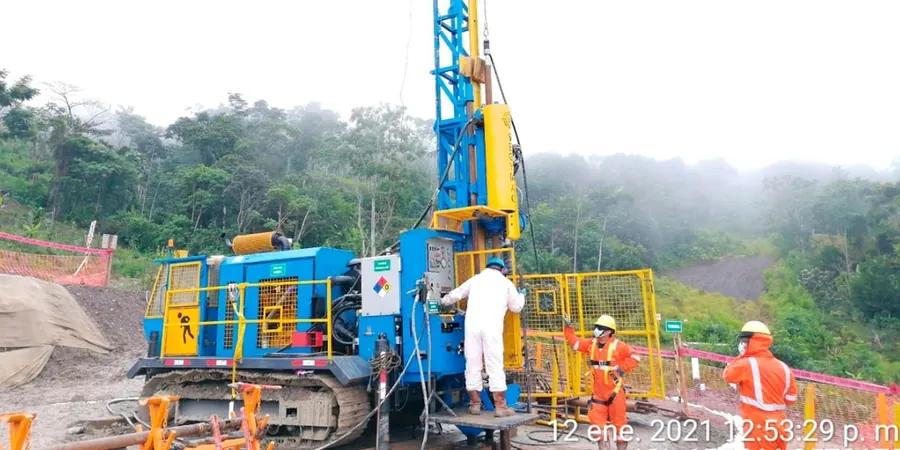
Typical technical challenges in Prince George
The Nechako River underfit valley contains buried paleochannels filled with loose, highly permeable gravels that do not appear on surface geological maps. Hitting one of these channels unexpectedly during a test pit excavation can flood the pit within minutes, even in February when the ground is frozen. A Lefranc test performed at 3–5 m depth in these gravels often returns k-values exceeding 1×10⁻³ m/s, demanding a complete rethink of the temporary works. Overestimating the silt continuity and under-designing the dewatering system leads to base instability in footing excavations and repeated construction delays. ASTM D4631 and D4630 provide the procedural backbone, but interpreting the flow regime — laminar versus turbulent — requires local experience with Prince George hydrogeology.
Our services
Our field permeability testing program in Prince George covers the full workflow from borehole selection to hydraulic parameter reporting.
Lefranc testing in overburden
Falling-head and constant-head permeability tests in soil, isolating screened intervals within glacial till, glaciofluvial sands, and lacustrine silts.
Lugeon testing in bedrock
Five-stage packer testing in fractured shale and sandstone bedrock to determine Lugeon values and assess groutability for cut-off curtains.
Packer permeability profiling
Multi-interval straddle-packer setups for vertical hydraulic conductivity profiling in exploration boreholes deeper than 30 m.
Dewatering parameter reporting
Reduction of field k-values to design inputs for wellpoint dewatering systems, open-cut sump sizing, and groundwater control permits.
Frequently asked questions
What is the difference between a Lefranc test and a Lugeon test?
A Lefranc test measures hydraulic conductivity in soil by injecting or withdrawing water through a screened interval, typically using falling-head or constant-head methods per ASTM D4631. A Lugeon test measures hydraulic conductivity and fracture behavior in rock by injecting water under five pressure stages per ASTM D4630, yielding a Lugeon value (1 Lu ≈ 1×10⁻⁷ m/s). In Prince George, we use Lefranc for the surficial glaciofluvial deposits and Lugeon for the underlying fractured bedrock.
How long does an in-situ permeability test take in the field?
A single Lefranc test in soil usually takes 30 to 60 minutes, depending on soil type and whether we run both falling-head and constant-head stages. A five-stage Lugeon test in rock typically requires 45 to 90 minutes per test interval. We can run multiple tests per day, provided the borehole stays open and stable.
What does a field permeability test cost in the Prince George area?
Field permeability testing in Prince George ranges from CA$810 to CA$1,260 per test interval, depending on depth, access conditions, and whether it is a Lefranc or Lugeon procedure. Mobilization, drilling crew time, and packer equipment are included in this range.
When is a Lugeon test required instead of a simple packer permeability test?
A Lugeon test is required when you need to assess fracture connectivity and groutability of bedrock — for dam foundations, cut-off curtains, or tunnel pre-excavation grouting. The five-stage pressure cycle reveals whether fractures dilate, wash out, or fill with fines under injection pressure, which a single-pressure test would miss.