Prince George sits at the confluence of the Fraser and Nechako rivers, where winter temperatures routinely drop below -30°C and the frost line can reach depths of 1.8 metres. These aren't just weather statistics—they're the primary design loads for any concrete pavement in the region. Rigid pavement design here starts with understanding that the subgrade will freeze, heave, and then saturate during spring thaw, creating a cyclical stress regime that few other Canadian cities experience with the same intensity. The silty-clay soils common across the Bowl area add another layer of complexity, because their drainage characteristics change dramatically between seasons. When we approach a project along Highway 16 or within the BCR Industrial Site, our first question is always about the water table fluctuation and the frost-susceptibility index of the native material, because those two factors determine whether a pavement will last 15 years or 40.
In Prince George, a concrete pavement joint is a controlled crack that must survive seventy annual freeze-thaw cycles while transferring heavy industrial loads—get the subgrade modulus wrong and that joint fails within two winters.
Methodology applied in Prince George
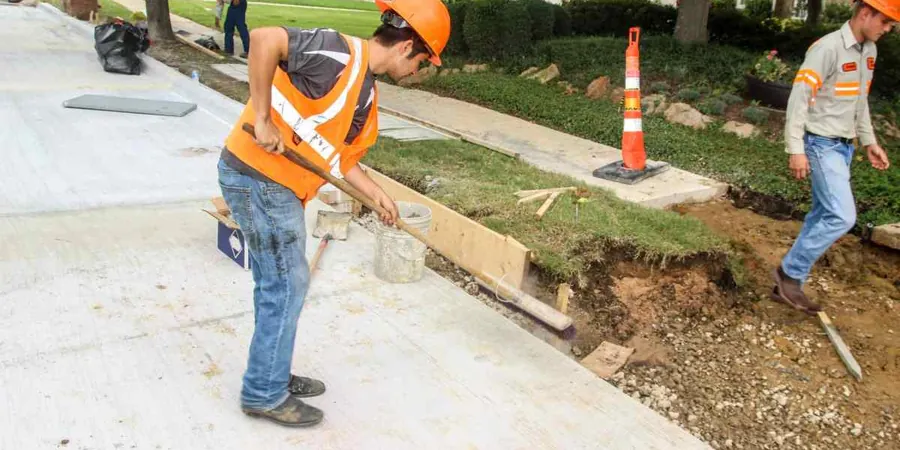
Typical technical challenges in Prince George
When we mobilize a concrete saw and a falling weight deflectometer to a site in Prince George, the real diagnostic work happens at the subgrade level long before the first concrete truck arrives. The most damaging failure mode we encounter isn't the obvious surface crack—it's the loss of support beneath the slab corners caused by pumping of saturated fines at the joints during spring thaw. Heavy logging trucks turning at low speed on an industrial lot generate hydraulic pressure pulses that eject subgrade material through unsealed joints, creating voids that lead to step faulting and eventual slab fracture. A pavement that ignores the drainage characteristics of the native Prince George silts will begin showing measurable distress at 5 to 8 years regardless of how well the concrete itself was placed. Our designs therefore insist on daylighted granular subbase layers and, where grades don't allow positive drainage, on longitudinal edge drains tied to stormwater infrastructure.
Our services
Our scope for rigid pavement design in northern BC extends from the geotechnical investigation through to the joint layout and concrete mix specification. Each project receives a subgrade characterization, a drainage plan, and a structural thickness calculation calibrated to local climate data.
Subgrade Reaction Modulus Testing
Field plate load tests conducted at subgrade and subbase levels to determine the k-value used in Westergaard-based thickness design, with seasonal adjustment factors for Prince George's freeze-thaw regime.
Joint and Reinforcement Layout
Design of transverse and longitudinal joint spacing, dowel bar sizing and placement, tie bar schedules, and isolation joint details at structures and manholes per ACPA and TAC standards.
Frost Protection and Drainage Design
Determination of non-frost-susceptible subbase thickness based on freezing index maps for the Prince George region, combined with subdrainage networks to prevent saturation pumping at slab edges.
Frequently asked questions
How much does a rigid pavement design cost for a typical commercial lot in Prince George?
For a standard commercial lot or small industrial yard, the design package including subgrade investigation, plate load testing, and full pavement design report typically runs between CA$2,940 and CA$9,770. The range depends on the number of borings required, the complexity of the drainage plan, and whether existing pavement cores need laboratory analysis.
Why does Prince George need thicker concrete slabs than the Lower Mainland?
The freezing index in Prince George exceeds 1,500 degree-days Celsius, compared to under 300 in Vancouver. This means the subgrade loses support capacity during prolonged freezing and becomes saturated during thaw, so the slab must bridge over softened zones. The required subbase thickness is also greater—typically 450 to 600 mm of clean granular material—to interrupt capillary rise and prevent frost lenses from forming directly beneath the concrete.
Do you test the concrete mix for alkali-aggregate reactivity given the local aggregate sources?
Yes. Many aggregate sources in the Prince George region contain reactive chert and volcanic fragments that can trigger alkali-silica reaction over time. We specify accelerated mortar bar testing per CSA A23.2-25A and, when necessary, recommend supplementary cementitious materials like fly ash or slag at replacement levels of 20 to 30 percent to mitigate expansion risk. More info.