Driving a pile through compressible silt near the Fraser or Nechako River gets expensive fast. That is where a well-designed stone column grid changes the economics of the project. In Prince George, the combination of glaciolacustrine deposits and post-glacial silts demands more than a generic textbook approach. Our team correlates local borehole logs with CPT data to size the columns correctly, ensuring load transfer works from day one. We apply the Priebe method and back it up with settlement calculations that reflect the actual stratigraphy found across the city's river terraces. For sites with layered soft ground, we often pair the stone column layout with a CPT test to map the transition between the crust and the weak zone without gaps in the data.
A stone column shifts the failure mechanism from undrained flow to drained bulging. In Prince George silts, that changes the factor of safety from borderline to comfortable.
Methodology applied in Prince George
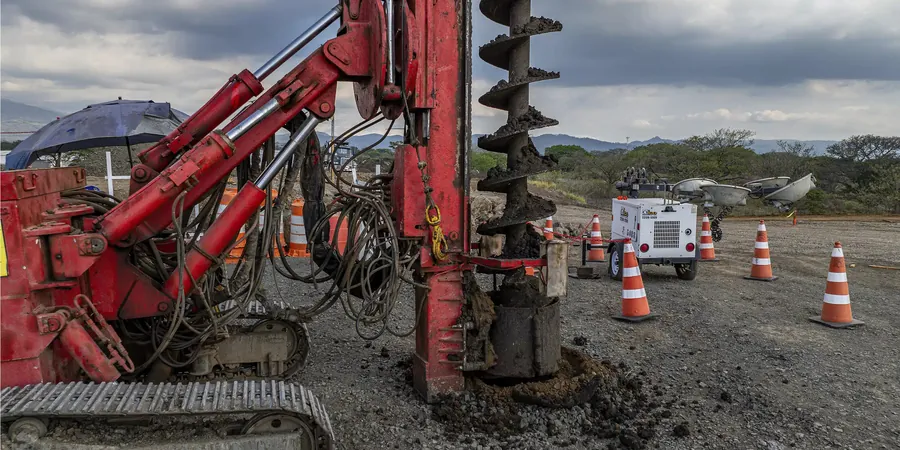
Typical technical challenges in Prince George
Prince George's industrial east side was developed over decades of incremental fill placement on former floodplain. The geotechnical legacy is a patchwork of uncontrolled fill, buried organics, and compressible native soil. Designing stone columns here means reconciling old as-built drawings with fresh site investigation data. The seasonal frost penetration, reaching up to 2 meters in exposed areas, can heave untreated ground around the column heads. We specify a granular working platform that doubles as a drainage blanket, preventing ice lens formation under the floor slab. The City of Prince George now requires performance verification tests on production columns, not just pre-production trials. A modulus test on every 50th column confirms that the installation is achieving the target stiffness. Without this, a building on the BCR Industrial Park could see 50 millimeters of differential settlement within the first five years.
Our services
We deliver the complete design package from field investigation through to construction quality control. Every project includes a signed and sealed report from a professional engineer registered in British Columbia.
Vibro-Replacement Design Package
Full analytical and numerical design including unit cell settlement analysis, bearing capacity checks, liquefaction assessment, and a detailed installation specification with column layout drawings.
Performance Verification Testing
Post-installation modulus tests, CPT profiling between columns, and zone load tests to confirm the ground improvement meets the design acceptance criteria.
Frequently asked questions
What is the typical cost range for stone column design in Prince George?
A complete design package for a typical commercial building pad or road embankment in Prince George typically ranges from CA$2,050 to CA$7,110. The final cost depends on the treated area, number of columns, and whether a 3D finite element analysis is required for complex loading or irregular grids.
How do stone columns perform in Prince George's fine-grained soils?
Performance depends heavily on the silt content and sensitivity. In low-plasticity silts, columns densify the surrounding soil effectively and provide rapid radial drainage. In highly sensitive clays, we reduce the area replacement ratio and use a bottom-feed method to minimize disturbance. Long-term settlement is controlled by the modular ratio between the stone and the soil, which we calibrate against CPT tip resistance.
What verification is required after installation?
We specify a combination of methods: CPT soundings at the centroid of a column triangle to measure density improvement, plate load tests on individual columns for modulus verification, and occasionally cross-hole shear wave testing to confirm the increase in small-strain stiffness. The City of Prince George typically requires submission of these results before issuing a foundation permit for improved sites.