The glacial till and glacio-lacustrine clays that dominate the Prince George basin present a real challenge for foundation design. The city sits at the confluence of the Fraser and Nechako rivers, at an elevation of about 575 meters, and the subsurface profile often shifts within a single block: dense, silty till over soft, normally consolidated clay. Shear strength parameters derived from a standard SPT correlation don't capture that variability accurately. We run triaxial tests to measure effective cohesion (c') and friction angle (φ') directly, because a pile group in College Heights and one in the Bowl area face completely different drainage conditions. The test also quantifies undrained shear strength (Su) for short-term loading, which is critical when excavation support is planned near the water table, typically found at just two to four meters depth in many parts of the city. When the project demands a precise modulus of elasticity for settlement prediction, we complement the triaxial program with in-situ permeability data to model the consolidation rate under the final structural load.
A single CU triaxial test with pore pressure measurement reveals more about a soil's true strength envelope than a dozen SPT correlations applied to Prince George's layered drift.
Methodology applied in Prince George
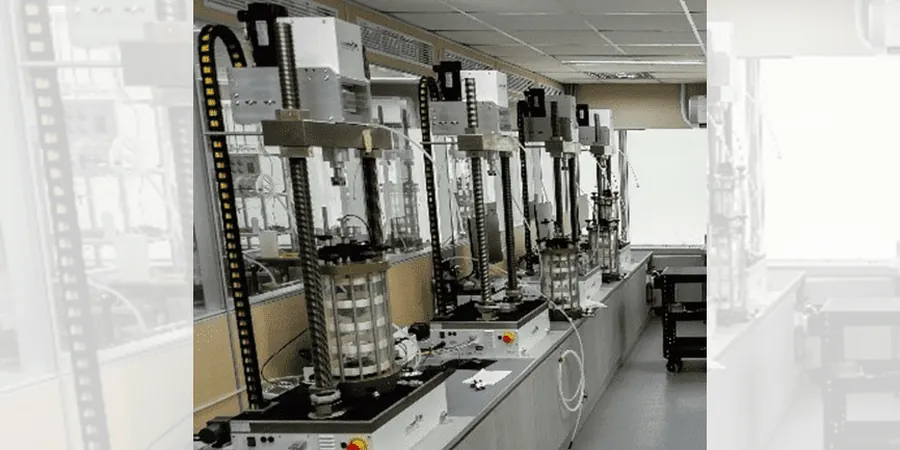
Typical technical challenges in Prince George
The contrast between the Hart Highlands and the downtown Bowl is instructive. In the Hart, the glacial till is dense and overconsolidated; a UU test might suggest a Su of 150 kPa, and a shallow footing works. Down in the Bowl, the same formation is buried under five meters of soft, compressible clay where a CU test shows Su dropping to 40 kPa and φ' barely reaching 24°. A foundation designed on UU data alone—without the effective stress path from a CU triaxial—risks underestimating long-term settlement by 30 to 50 percent in the Bowl's normally consolidated soils. Skipping the drained test on a silt till that dilates during shear can also overpredict the bearing capacity, leaving the structure with a false sense of safety. We've seen the cost of a supplementary triaxial campaign run about half a percent of the foundation budget, while the cost of a failed excavation support in saturated Prince George clay can run into the hundreds of thousands.
Our services
Triaxial testing is never a standalone exercise. We structure the laboratory program around the specific failure mechanisms that govern the project, combining the following services to deliver a complete strength and deformation profile.
Consolidated-Undrained (CU) with Pore Pressure
Measures effective stress strength envelope (c', φ') and excess pore pressure response. Essential for staged construction analysis and soft clay evaluation in Prince George.
Stress Path and Modulus Testing
Follows specific stress paths (e.g., K0 consolidation) to derive the Young's modulus and Poisson's ratio for FEM numerical models used in deep excavation design.
Unconsolidated-Undrained (UU) Quick Strength
Provides rapid undrained shear strength (Su) for preliminary design and quality control during earthworks, particularly useful for compacted fill verification.
Frequently asked questions
How much does a triaxial test program cost for a project in Prince George?
A typical triaxial testing program in Prince George ranges from CA$2,320 to CA$4,160, depending on the number of specimens and the test modes required. A three-specimen CU set with pore pressure measurement costs more than a single UU test, but the CU data often reduces foundation size and eliminates overconservatism, paying for the lab work several times over.
Which triaxial test type do I need for a foundation on the Prince George clay?
For the soft, normally consolidated clay found in the Bowl and near the river confluences, a consolidated-undrained (CU) test with pore pressure measurement is the standard choice. It yields the effective stress parameters needed for both short-term stability and long-term settlement analysis. If the load application is very slow relative to the soil's permeability, a consolidated-drained (CD) test may be specified instead.
How long does it take to get triaxial test results?
A standard CU triaxial test with three specimens takes about two to three weeks from sample extrusion to final report. The consolidation phase alone can require two to five days per specimen for the local silty clay, depending on the drainage path length. We provide preliminary Su values within a few days for urgent decisions.
Do you extract the soil samples for the triaxial test yourselves?
We coordinate directly with drilling crews operating in Prince George to obtain undisturbed Shelby tube samples. The tubes are transported to the lab in insulated containers to minimize disturbance. Before extrusion, we perform X-ray radiography on the tubes to select the most homogeneous sections, avoiding fissures and gravel lenses that would invalidate the test.