In-situ testing in Prince George provides direct evaluation of subsurface conditions without sample disturbance, essential where glacial till, lacustrine clays, and alluvial sands dominate the local geology. These methods verify compaction and assess bearing capacity in real time, aligning with CSA A23.2 and ASTM standards referenced across British Columbia. Reliable field data starts with a precise field density test (sand cone method), widely specified for confirming engineered fill placement and subgrade preparation on commercial and municipal projects throughout the region.
Residential subdivisions, highway twinning through the Nechako lowlands, and industrial pads near the BCR Industrial Site routinely require in-situ verification to satisfy geotechnical reports and municipal permitting. Complementing density checks, sand cone density testing pairs seamlessly with nuclear gauge correlations and proof rolling observations for comprehensive compaction acceptance. Our team executes these programs efficiently, delivering defensible results that keep Prince George earthworks and foundation construction on schedule.
An anchor’s capacity is only as reliable as the bond zone geology—and in Prince George, that means knowing exactly where the till ends and the bedrock begins.
Methodology applied in Prince George
Typical technical challenges in Prince George
A five-storey mixed-use project on Victoria Street ran into trouble when the contractor assumed passive rock bolts would work in what turned out to be a decomposed siltstone layer at 6 m depth. The first three anchors crept more than 5 mm in 10 minutes under test load. We redesigned the system with deeper active anchors socketed into competent rock below 9 m, adding a shotcrete facing to distribute the reaction loads. The lesson applies to much of downtown Prince George: the bedrock surface is irregular, and what looks like solid rock in a borehole log can be a weathered seam that won’t hold bond stress. Proof testing every anchor on site—not just a sacrificial few—is the only way to catch these zones before the excavation proceeds.
Our services
Anchor design in Prince George spans temporary excavation support and permanent retaining structures. Our work integrates geotechnical investigation, load testing, and long-term monitoring:
Active Strand Anchor Systems
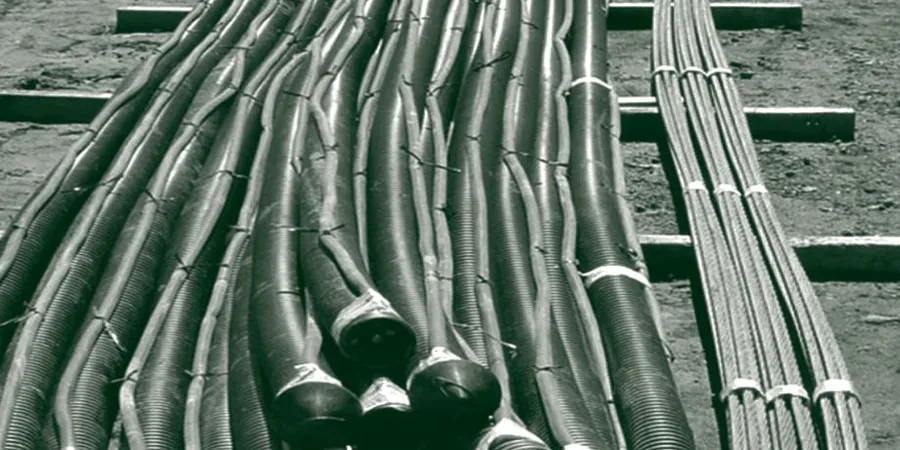
Post-tensioned anchors with 3 to 15 strands, designed for tieback walls and bridge abutments. We handle bond length calculations in glacial till, lock-off procedures, and lift-off testing to verify residual loads.
Passive Bar Anchor Systems
Fully grouted threadbar anchors for soil nail walls and rock slope stabilization. We specify bar grade, drill hole diameter, and grout mix based on the shear strength of the local till and clay units.
Anchor Load Testing and Monitoring
Performance, proof, and creep tests per PTI standards. We use hydraulic jacks with digital load cells and dial gauges, plus long-term monitoring with vibrating wire load cells for permanent anchors.
Frequently asked questions
What’s the difference between active and passive anchors for a retaining wall in Prince George?
Active anchors are tensioned after installation to apply a predetermined load to the structure before any soil movement occurs. Passive anchors only develop resistance when the ground starts to displace. In Prince George’s glacial till, we recommend active systems when you need to control lateral deflections—say, next to an existing building on George Street. Passive systems work well for temporary cuts in competent till where a few millimeters of movement are acceptable.
How much does anchor design and testing cost for a typical project in Prince George?
For a design package covering anchor selection, bond length calculations, and on-site proof testing, budgets in Prince George typically run between CA$1,470 and CA$5,820, depending on the number of anchors and whether permanent corrosion protection is required. A small soil nail wall with four passive anchors sits at the lower end; a multi-strand active tieback system with lift-off testing and load cells lands at the upper end.
How deep do anchors need to go in Prince George’s soil to reach competent bond material?
It depends entirely on the neighborhood. In the Cranbrook Hill area, dense basal till can provide good bond at 4 to 6 meters. Down in the Bowl, near the rivers, you may encounter 8 to 12 meters of softer lacustrine clay before hitting till or siltstone. We rely on test pit or SPT drilling data to map the bond zone before sizing the free and bond lengths.