Prince George sits at the confluence of the Nechako and Fraser Rivers, and that riverine geography means one thing: thick deposits of alluvial silts and sands underfoot. The 53.9°N latitude doesn't make us immune to seismic events—the region falls within the stable continental interior zone, but NBCC 2020 still assigns a seismic hazard value that demands attention for critical infrastructure. When saturated granular soils like the ones found in the Bowl area or along River Road get shaken, they can lose strength fast. That's where a thorough soil liquefaction analysis becomes essential. We run SPT-based evaluations following the NCEER/Youd-Idriss framework, pairing field data from spt-drilling with lab grain-size curves to calculate the factor of safety against liquefaction at each layer. It’s not about scaring anyone off a build—it’s about knowing exactly what mitigation, if any, the ground demands before you pour the first cubic meter of concrete.
Liquefaction doesn't just happen in California—saturated river sands in Prince George can lose shear strength under cyclic loading, and the NCEER method is how we quantify that risk layer by layer.
Methodology applied in Prince George
What comes out the other end is a clear, color-coded cross-section showing zones of high, moderate, and low liquefaction risk, tied directly to the NBCC site class. If the factor of safety dips below 1.1 in a layer that supports a footing, the report flags it and recommends either ground improvement or a deep foundation alternative. The whole process, from mobilization to final stamped report, typically runs two to three weeks, depending on the size of the program.
Typical technical challenges in Prince George
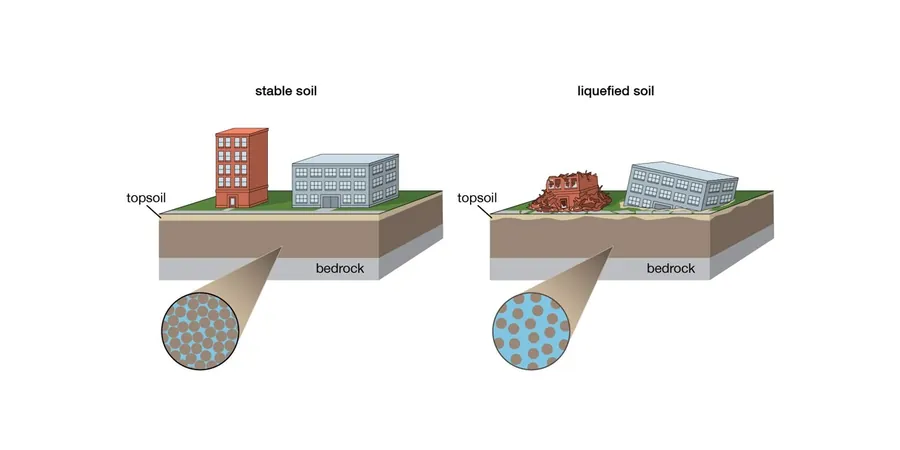
I recall a commercial project near the Nechako River bank where preliminary borings came back with clean sand lenses at 4 to 7 meters depth, sitting below the water table. The developer had planned a three-story steel frame on shallow footings. When we ran the liquefaction numbers using the SPT blow counts and the NBCC PGA for a 2% in 50-year event, the factor of safety dropped to 0.6 in that layer—meaning the sand would likely liquefy and the footings could punch through or tilt. They hadn’t budgeted for ground improvement. We sat down with the structural engineer and pivoted the design to stone-columns installed by vibro-replacement, which densified the sand and provided drainage paths to dissipate pore pressure. The fix added cost, sure, but it was a fraction of what a post-earthquake repair would have been. That’s the conversation we have with every Prince George client: the analysis isn’t a bureaucratic checkbox, it’s a financial hedge against a low-probability, high-consequence event.
Our services
Our Prince George liquefaction work splits into two connected phases: the field investigation and the desk analysis. You can engage them together or phase the work if budgets are tight.
Seismic Site Response & Liquefaction Triggering
Using SPT or CPT field data, we compute the cyclic stress ratio (CSR) and cyclic resistance ratio (CRR) for every granular layer above bedrock. The output is a factor-of-safety profile and an LPI map that NBCC and CSA A23.3 accept for foundation design. This is the core deliverable for any structural engineer designing to seismic provisions in Prince George.
Ground Improvement Feasibility Studies
When liquefaction is confirmed, we evaluate densification, drainage, and stiffening alternatives—vibrocompaction, stone columns, deep soil mixing—against the site's access constraints and silty sand gradation. The report includes post-treatment SPT verification criteria so you can prove the ground meets the performance spec before the building permit closes.
Frequently asked questions
Does Prince George really have a liquefaction risk? I thought that was a coastal problem.
It's a fair question. Liquefaction requires three things: loose granular soil, saturation, and shaking. Prince George has the first two in spades along the river corridors, and the NBCC 2020 seismic hazard maps assign a non-zero PGA even for the interior. We've measured N1,60 values below 15 in clean sands at several Bowl-area sites, which triggers a liquefaction evaluation under the code. The risk is real, just lower probability than Vancouver.
How much does a soil liquefaction analysis cost for a typical commercial lot in Prince George?
For a standard commercial lot requiring two to three boreholes with SPT sampling, lab index testing, and the full liquefaction triggering report, budgets typically run between CA$3,500 and CA$5,380. The spread depends on access for the drill rig, depth to refusal, and whether we need to add CPT soundings to fill in data gaps. We provide a fixed-price proposal after reviewing the geotechnical investigation plan.
How long does the analysis take from start to finish?
Fieldwork usually takes one to three days on site, depending on the number of boreholes. Lab testing adds another five to seven business days. The engineering analysis and report drafting take about a week. For a typical commercial project, expect a final stamped report in three to four weeks from mobilization, though we can expedite for a surcharge if the excavation contractor is waiting.
What's the difference between SPT-based and CPT-based liquefaction analysis?
SPT-based analysis uses blow counts from a split-spoon sampler and gives you a physical soil sample to classify. CPT-based analysis uses a cone pushed at constant rate to get continuous tip resistance and pore pressure data—faster, no samples, but excellent stratigraphic detail. In Prince George's mixed soils, we often combine both: SPT for sampling and lab tests, CPT to fill in the profile between boreholes. The NCEER method works with either dataset.
Can you sign off on a foundation design if liquefaction is found?
Yes, but the path changes. If the factor of safety is below 1.0, we cannot recommend shallow footings without ground improvement. The report will specify the required post-treatment N1,60 values and the verification testing protocol. Once the ground improvement contractor meets those specs and we confirm with post-treatment SPTs, we issue a letter of conformance that the structural engineer uses to close the permit. If the owner prefers deep foundations, we shift the analysis to downdrag and lateral spreading loads on piles.