A three-storey mixed-use building on 15th Avenue hit refusal on loose glaciofluvial sand at just 1.8 m depth. The bearing capacity was borderline, and the site sat within NBCC Seismic Category D. Instead of deep foundations, the structural engineer requested a vibrocompaction design — a ground improvement solution that uses depth vibrators to densify the soil in place. In Prince George, where the Fraser and Nechako rivers have left behind thick sequences of Holocene sands with variable silt content, vibrocompaction often makes more sense than over-excavation or piling. The design must define grid spacing, vibration energy, and duration per point, then verify performance through pre- and post-treatment CPT testing and SPT drilling correlated to relative density targets above 70%.
The difference between marginal and acceptable bearing capacity in Prince George often lies in 15 seconds of vibration time per meter.
Methodology applied in Prince George
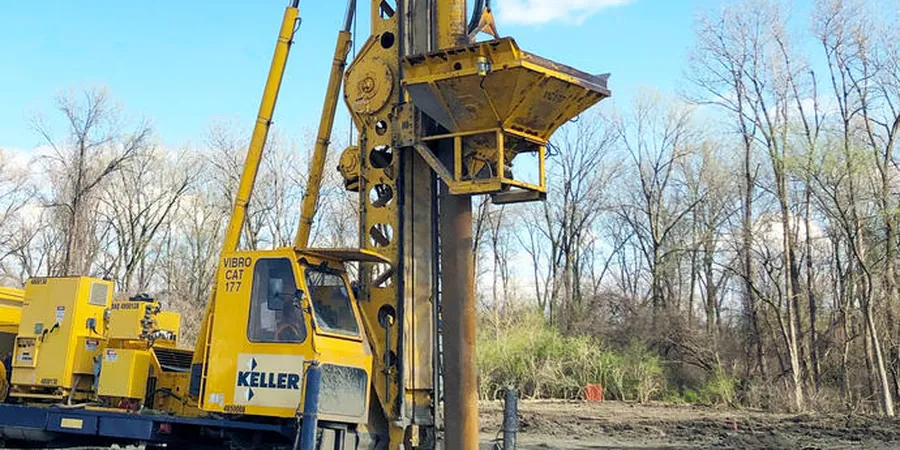
Typical technical challenges in Prince George
Prince George expanded rapidly along the Fraser-Nechako confluence during the 1960s pulp mill boom, pushing light industrial and commercial buildings onto floodplain deposits that were never engineered for modern seismic loads. Undertreated zones — often where silt lenses interrupt vibrator energy propagation — remain loose and can trigger differential settlement under cyclic loading. We have seen projects where skipping a pilot test grid added four weeks to the schedule because the design parameters didn't match the actual grain-size variability. The NBCC 2020 assigns Prince George a PGA of 0.15–0.20 g on firm ground; site class amplification on loose sand can push spectral acceleration well above design assumptions. A liquefaction assessment using SPT-based triggering per Youd & Idriss (2001) is mandatory when the water table is within 5 m of the treatment depth. Post-treatment verification that skips centroid testing leaves blind spots: the weakest soil is between probe points, not at the probe location — we insist on testing at mid-grid positions.
Our services
Our vibrocompaction design package covers the full ground improvement cycle — from feasibility assessment through post-treatment verification — calibrated to Prince George's glaciofluvial soil conditions and seismic requirements.
Treatability and Grain-Size Assessment
Sieve and hydrometer analysis per ASTM D422 to determine fines content and confirm vibrocompaction applicability in Prince George Formation sediments.
Pilot Test Grid and Energy Calibration
Instrumented test section with real-time ammeter recording and stepwise withdrawal to establish vibration time per meter and probe spacing for target relative density.
Post-Treatment CPT Verification
Cone penetration testing at inter-probe centroid locations comparing pre- and post-treatment tip resistance, friction ratio, and pore pressure dissipation.
Frequently asked questions
What grain-size conditions make vibrocompaction suitable in Prince George?
The method works best on clean to slightly silty sands with less than 12–15% passing the No. 200 sieve. Much of the Prince George Formation meets this criterion, but silt content can increase near the Nechako River floodplain. We always run a full grain-size distribution per ASTM D422 before committing to a vibrocompaction design — if fines exceed 15%, stone columns or rigid inclusions may be more appropriate.
How much does a vibrocompaction design program cost for a typical Prince George site?
Design and verification packages including pilot testing, CPT baseline and post-treatment runs generally range from CA$1,770 to CA$7,780 depending on grid size, depth, and number of verification points. A small commercial lot with a single test section falls at the lower end; multi-grid industrial pads with deep treatment and extensive QA/QC run higher.
How is the depth of improvement verified after vibrocompaction?
We use CPT soundings at centroid positions between vibrator probe points because that's where density is lowest post-treatment. We compare cone resistance (qc) and sleeve friction (fs) against pre-treatment baselines. The acceptance criterion is typically a minimum 80% increase in qc through the target zone, with continuous refusal profiles confirming treatment extends to the design depth. SPT calibration boreholes are added for projects requiring N60 correlations for liquefaction analysis.