A common mistake we see in Prince George is assuming that a standard SPT blow count gives you the full seismic picture. It does not. The National Building Code of Canada now requires a measured VS30 value for site classification on many projects, and relying on default assumptions can push your design into a higher seismic category than the soil actually warrants. A proper MASW survey directly measures shear wave velocity in the top 30 meters, giving you a defensible Site Class C, D, or E determination. When we run these surveys along the Nechako River terraces or in the glacial till deposits that dominate the bowl, the results often surprise engineers who had been using correlated data. Pairing the MASW line with a few SPT drill holes lets us calibrate the velocity profile against actual penetration resistance, and for deeper basin effects we sometimes add a seismic refraction line to map the bedrock interface.
A measured VS30 in Prince George glacial till often upgrades a site from assumed Class D to Class C, directly reducing the seismic design loads.
Methodology applied in Prince George
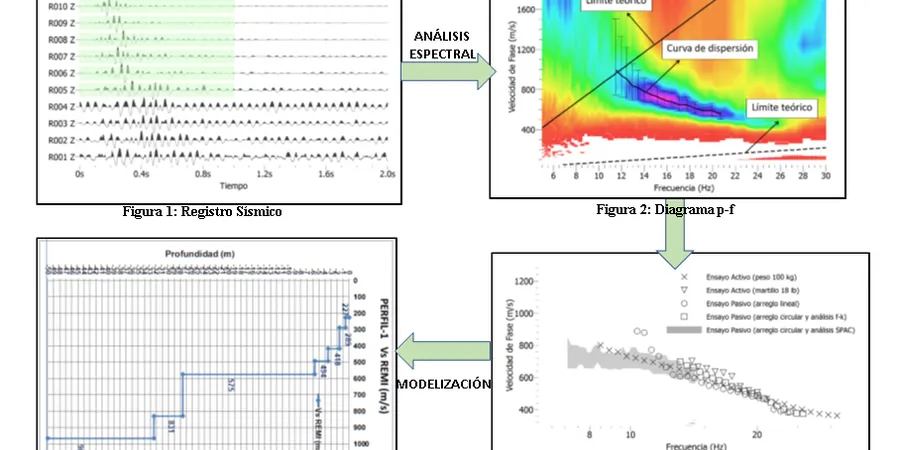
Typical technical challenges in Prince George
Prince George sits in a moderate seismic hazard zone, but the real risk amplifier is the soil column. The city is built on a mix of glaciolacustrine silts, clays, and outwash sands up to several hundred meters thick in the Fraser Basin. Soft silt layers at depths of 5 to 15 meters can produce a significant impedance contrast that traps seismic energy. We have measured VS30 values below 180 m/s in some low-lying commercial lots near the river, pushing those sites into Site Class E. That classification triggers higher spectral accelerations and can double the required lateral force-resisting capacity compared to a Class C site just a kilometer away on higher till. Without an on-site MASW survey, a designer would never know. The cost of overdesigning for the wrong class — or worse, underdesigning — dwarfs the survey cost by orders of magnitude.
Our services
Our MASW work in Prince George typically comes as part of a broader geotechnical investigation. These are the two core services that accompany every VS30 survey.
NBCC Site Classification Package
Complete MASW survey with VS30 computation and formal site class letter stamped by a BC-registered professional engineer. Includes dispersion curves, velocity profiles, and a comparison of measured vs. assumed site period for the NBCC seismic design parameters.
Vs-Based Liquefaction Screening
Using the shear wave velocity profile from the same MASW dataset to run a liquefaction potential index analysis per Youd and Idriss methodology. Particularly relevant for Prince George sites within 500 m of the Fraser or Nechako River channels.
Frequently asked questions
What does a MASW survey cost for a typical Prince George building lot?
For a standard commercial or industrial lot in Prince George, a complete MASW survey with VS30 computation and a stamped site class letter runs between CA$2,380 and CA$3,770 depending on the number of spreads required and access conditions. Sites with heavy bush or steep grades take longer and fall at the upper end.
How long does the field work take, and will it hold up my excavation schedule?
Field acquisition for a single-building site takes about half a day. We process the data back at the lab and deliver the draft VS30 profile within three business days. The survey is entirely surface-based — no drilling, no excavation, no disturbance — so your earthworks contractor can proceed on other parts of the site while we work.
Can MASW work on frozen ground in a Prince George winter?
Yes, and we do it regularly. Frozen surface crust actually improves geophone coupling once the spike is driven through the frost layer. The Rayleigh wave penetration depth is far greater than the frozen crust thickness, so the underlying unfrozen soil controls the dispersion curve. We do pre-heat the striker plate area with a propane torch on days below -20 °C to prevent brittle fracture.
How does a measured VS30 compare to using the SPT-N correlation in the BC Building Code?
The SPT-N to VS30 correlations in the code are conservative by design. In Prince George glacial till, we routinely measure VS30 values 20 to 40 percent higher than the correlation would predict. That difference often bumps a site from Class D to Class C, reducing the design base shear and saving real money on structural elements. A direct measurement replaces the correlation penalty with physical data.